StoreEase Names Bill Mottram President of Self Storage Operations
EaseOS
The Operating System for Modern Self-Storage
August 18, 2026
BIRMINGHAM, Ala. — StoreEase, the AI-native operating system for self-storage, today announced that Bill Mottram has joined the company as President of Self Storage Operations. Mottram joins from Extra Space Storage, where he spent more than eight years in senior operational roles, and brings that experience to a company rethinking how the industry is run from the ground up.
StoreEase operates stores through a virtual operating model that centralizes leasing and management across the portfolio, replacing the single-store staffing model with technology-enabled teams operating at scale. In his new role, Mottram will lead the company's self-storage operations across its owned and managed portfolio, positioning that model for its next phase of growth.
“Bill has operated at the highest level in this industry, and he understands where it’s heading,” said Josh Boyd, Founder and CEO of StoreEase. “What excites me most is the combination. You take a strategic operator of Bill’s caliber, put him on top of the technology and operational foundation we’ve spent years building, and the two compound: world-class operating judgment, amplified by a platform that lets it reach every store at a fraction of the cost. The market consolidation opportunity in front of us is massive, and Bill puts us in a far stronger position to seize it.”
“StoreEase has built the most advanced technology platform I’ve seen in this industry,” said Bill Mottram, President of Self Storage Operations. “The portfolio-wide visibility and control it provides translate directly into greater efficiency and stronger NOI for owners, and a materially better experience for their customers. Technology that lets high-caliber teams operate at scale is the future of this industry, and I couldn’t be more excited to be here.”
StoreEase’s operating system combines an AI-native omni-channel system of action with a physical hardware footprint deployed across its store network, giving operators a single operating layer that sits on top of existing property management systems. It’s the foundation of StoreEase’s virtual operating model: centralizing leasing and management so high-caliber teams can run entire portfolios, not single stores. The company will continue to execute on that model across its owned and managed portfolio while extending the operating system to licensed operators, positioning StoreEase to help consolidate a fragmented industry.
About StoreEase
StoreEase is an AI-native operating system for the self-storage industry, combining software, hardware, and tech-enabled services to help operators run more efficiently across owned, managed, and third-party managed stores. Through its virtual operating model, StoreEase provides full-service third-party management for owners seeking to maximize efficiency, NOI, and customer experience across their portfolios.
How enhanced office coverage turns unstaffed hours into revenue opportunities.
Move-in data · 9-month off-peak period · 100+ stores
Executive Summary
Self storage has historically been torn between two models. The traditional model staffs an office during business hours and accepts coverage gaps before opening, at lunch, after close, and whenever a manager is pulled away. The remote and unmanned model eliminates the office and staff entirely, and with it every rental and service opportunity that walks up to a closed office is deflected to other channels or, more likely, lost outright.
This study demonstrates a third path. It enhances the traditional model with a hybrid approach: it keeps the office open with expanded hours and no coverage gaps. The Virtual Console turns assumed coverage into verified coverage. Every store gets consistent, high-quality managers with greater presence driving revenue and customer experience at a fraction of traditional staffing economics.
The evidence has been hiding in plain sight. A property management system records where a lead was generated. It does not record the customer’s journey or where the lease was actually signed. EaseOS transaction-level data reconstructs that journey across 18,750 unique move-ins over nine months.
The Headline Numbers
41% of all new rentals are signed at the Virtual Console.
60% VC engagement — the VC interacts with 60% of new customers before, at, or immediately after the rental.
29.4 additional rentals per store, every year — captured purely in expanded hours.
7,635 leases closed at the counter across 100+ stores over nine months.
2,311 move-ins during unstaffed hours, captured outside physically staffed hours.
1. The Industry’s Two Models, and the Gap Between Them
Under the traditional model, a staffed office converts walk-in demand, but only during staffed hours. Under the remote and unmanned model, there is no office presence at all. This study uses EaseOS transaction-level data to reconstruct the customer journey, and the reconstructed picture shows the office is the highest-leverage point in the journey, provided it is always open.
2. Where Leads Are Sourced and Generated
Every move-in is unique, with a customer journey mapped from exactly one lead source. Regardless of where the lead is generated, the VC engages 60% of new customers (11,170 of 18,750) before, at, or immediately after the rental.
Lead source
Move-ins
Used VC
VC used %
Signed @ VC
Office and Phone
7,157
5,424
76%
4,385
Web
6,121
2,645
43%
1,295
Third-party marketplace
3,728
2,197
59%
1,422
Other
1,744
904
52%
568
Total
18,750
11,170
60%
41%
Office and Phone combines manually-keyed leads with leads that originated at the Virtual Console itself, both office-driven entry paths. Its high VC usage (76%) partly reflects how and when these leads are captured rather than superior channel quality alone.
3. How to Attribute the VC’s Role to Lease Signing
Of all 18,750 move-ins portfolio-wide, 7,697 (41.1%) were signed on or after a VC touch. Both attribution definitions put roughly 41% of new rentals at the Virtual Console.
Population
Records
% of move-ins
Attribution treatment
Signed same day as first VC touch
6,304
33.6%
VC-assisted, tight temporal link
Signed proximal to VC touch
1,393
7.4%
Strongest causal candidate (nurtured)
Not VC-attributable
11,053
58.9%
No rental credit claimed
Total move-ins
18,750
100%
—
4. When These Rentals Happen
A conservative analysis of coverage gaps found 2,311 move-ins (30.3%) occurred during hours when a store was not physically staffed — before opening, the lunch hour, and after close.
Unstaffed-Hours Breakdown
Unstaffed window
Move-ins
Share
Before opening (7–8 AM)
287
12%
Lunch hour (12 PM)
860
37%
After close (5–8 PM)
1,164
50%
Total expanded hours
2,311
100%
5. Incremental Capacity: Rentals Per Store, Per Month
Normalizing expanded-hours volume across the portfolio quantifies what the VC adds beyond the limits of traditional staffing.
Unstaffed window
Total move-ins
Per store / mo
Per store / yr
Before opening (7–8 AM)
287
0.30
3.7
Lunch hour (12 PM)
860
0.91
10.9
After close (5–8 PM)
1,164
1.23
14.8
Total expanded hours
2,311
2.45
29.4
6. The Expanded Hours Business Case
Every store in the portfolio captures a conservative 2.45 rentals per store per month it would most likely not have captured if traditionally staffed — near-pure incremental revenue at minimal staffing cost.
Incremental rentals2.45per store, per month
Added per year29.4rentals per store
Equivalent to+1 moof rentals added per store, per year
The Bottom Line
The most notable incremental figure is approximately 3,080 incremental leases per year portfolio-wide, closed during unstaffed hours with no marginal labor cost, where the VC is the sole channel by necessity. This nine-month window falls largely within the off-peak season; a full year including spring/summer peak would likely push the total higher.
Methodology
All figures are unique, deduplicated move-ins reconstructed from EaseOS transaction-level data. Rental credit is claimed only for leases signed on or immediately after the first VC interaction. Period: a recent nine-month off-peak season, 100+ stores.
See What This Looks Like at Your Facilities
EaseOS plugs into the management, access control, and payment systems you already run. Most operators see the operating system working in their business in as little as two weeks.
Birmingham, Ala. · September 1, 2026 · For Immediate Release
BIRMINGHAM, Ala., September 1, 2026 — StoreEase, an AI-native operating system for the self-storage industry, today announced the release of the Virtual Console Flex, a new deployment of its EaseOS operating system that brings AI-powered coverage into traditionally staffed stores without disrupting the operator’s current operating model or office.
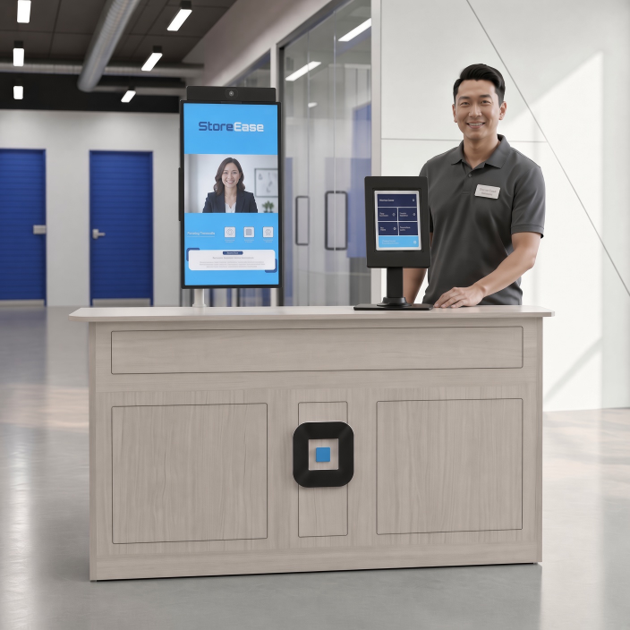
The Virtual Console Flex deploys onto the counter an operator already has, with no construction and no front-office reconfiguration.
Self-storage operators are navigating one of the toughest macro environments in years. With revenues flat and payroll costs climbing, operators are squeezed from both sides and forced to choose: expand hours and absorb the added payroll cost, or live with the limitations of the staffed model and miss the rentals that fall outside it. The Virtual Console Flex removes that tradeoff. It layers EaseOS’s AI-native technology onto the store an operator already runs, allowing on-site teams to keep working as they do today while the Console extends the hours, covers the gaps, and enhances the capabilities of the store.
“The Virtual Console Flex is designed to enable operators the flexibility to capture every customer in any office, any operating model, at any property. It’s the fastest path we’ve ever built to get our technology into an office and start driving revenue.”
Josh Boyd · Founder and CEO, StoreEase
AI That Sees and Responds
The Virtual Console Flex runs on real AI, not a static kiosk. Enhanced people detection lets the Console recognize the moment a tenant approaches the counter and engage them before they have to ask. Because the underlying hardware is future-proofed, new AI capabilities ship as software updates directly to the unit, so the Console an operator installs today continues to gain functionality over time.
Coverage That Never Clocks Out
The Virtual Console Flex expands operating hours and fills the gaps a staffed model leaves behind, including lunch breaks, early mornings, evenings, weekends, and the moments a manager steps away from the counter. During those windows, the Console greets tenants, answers questions, and keeps the store running.
Revenue When the Lights Would Otherwise Be Off
Every hour an on-site manager is not present means missed rental opportunities in stores. The Virtual Console Flex changes that, capturing move-ins and closing rentals during coverage gaps that previously went to voicemail or a locked door.
1–2
Months Gained
A recent StoreEase case study found that the expanded hours and recovered coverage gaps amount to the equivalent of one to two additional months of rentals per store per year, revenue that the limitations of a traditionally managed store leave on the table. Read the case study →
Built for the Office You Already Have
The Virtual Console Flex is a mount, plug, and play deployment that requires no construction, no contractors, and no front-office reconfiguration. Removing the build-out removes the cost and the downtime that come with it, so operators install in a single visit rather than budgeting a capital project, all while preserving the staffed model, front office, and team they already have.
All-New, AI-Enabled Ease Core
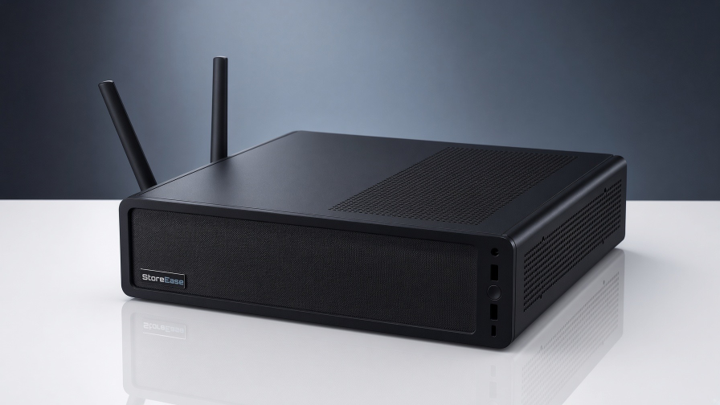
The Virtual Console Flex is powered by the all-new Ease Core: compute, passive cooling, and cellular backup in a single compact unit.
The all-new Ease Core: compute, passive cooling, and cellular backup in a single compact unit.
AI ComputeReal-time on-device AI that keeps getting smarter, with new capabilities shipping as software updates after install.
Passive CoolingSilent operation with no moving parts to fail.
Cellular BackupThe store stays connected when the primary line goes down.
The Virtual Console Flex is available now, including for groups who want to white-label EaseOS technology and deploy within their own operating system.
See the Virtual Console Flex at Your Facilities
The Virtual Console Flex mounts onto the office you already have, with no construction and no reconfiguration. Most operators are live within a single visit.
About StoreEase StoreEase is an AI-native operating system built for the self-storage industry. Its core product, EaseOS, is an omni-channel system of action that sits on top of the property management system and handles day-to-day store operations more efficiently. StoreEase pairs AI-native software with purpose-built hardware to help operators expand coverage, improve margins, and grow revenue without rebuilding their operating model. StoreEase is headquartered in Birmingham, Alabama.
Media contact: michael@storeease.com · StoreEase, Inc., 3800 Colonnade Parkway, Suite 650, Birmingham, AL 35243
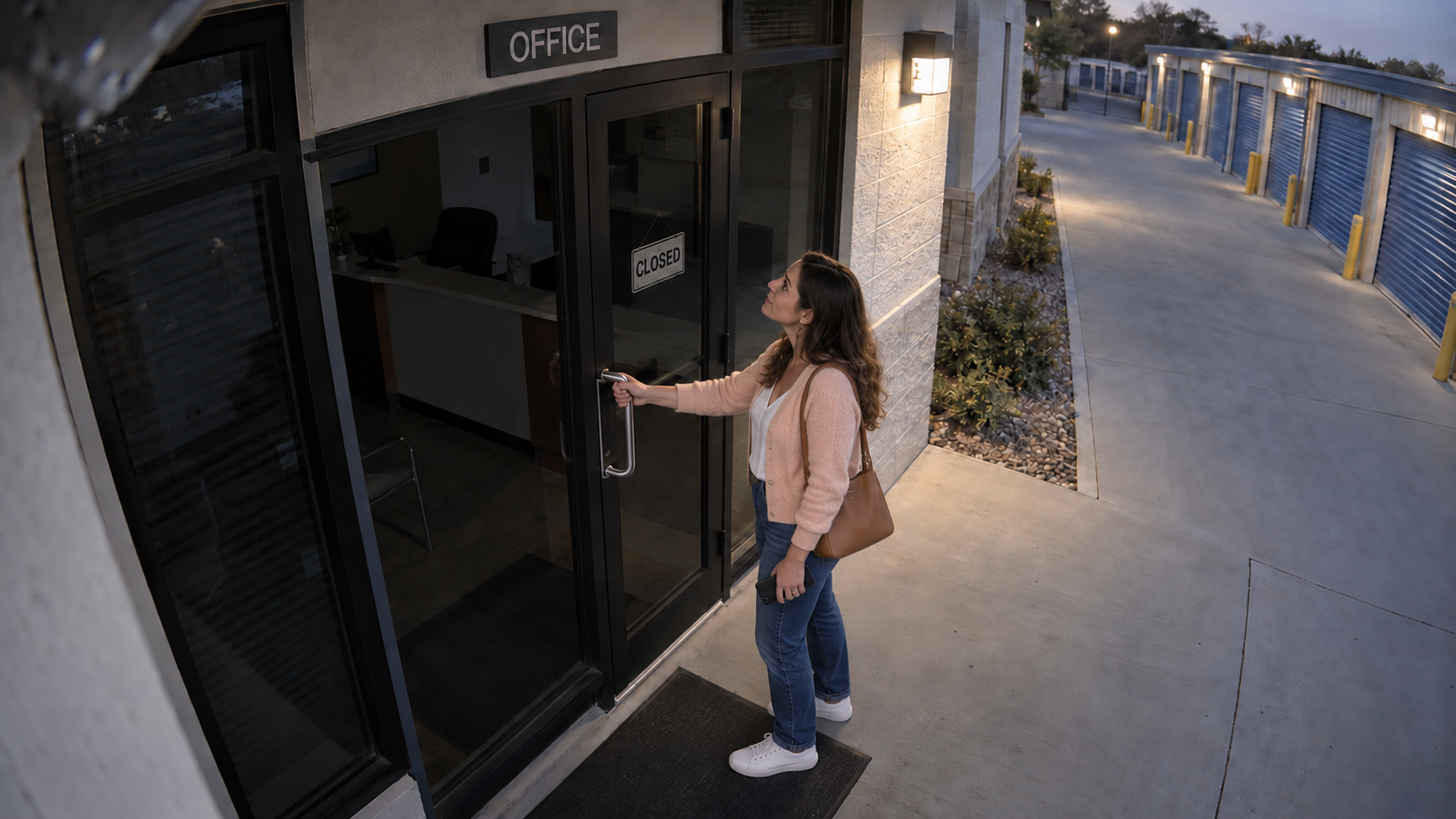
Walk up to most self storage offices early in the morning, at lunchtime, or after five, and you will find a locked door and, at best, a phone number, a QR code, or a cold, unfriendly kiosk. At unmanned and hybrid stores, that locked door is not the exception; it is most of the day, or all of it. That door stands in front of the best-converting channel in the business, at the very moment a customer in the middle of a life change is looking for a friendly face. Every pull on that locked handle is a rental or a service moment walking away in disappointment, and no report will ever show it.
I know because I watched it happen. As an investor and developer, I went down the kiosk-and-QR-code road myself to cut office payroll. Then I watched the security footage: customers walking up to my office, looking for someone to help them, and leaving without renting or getting the service they came for. Once you see that, you cannot unsee it. As an owner, it haunts you. It is why I stopped asking how to cut the office and started asking how to keep it open and staffed.
Everything that follows comes from operating data, not theory: more than seven years running self storage offices on our virtual operating model, and more than three running it with partners, across hundreds of stores. That data points to a conclusion that runs against where much of the industry has shifted under payroll pressure and a belief that the rental journey is moving fully digital.
Retail saw it first: digital sent shoppers to the store. A 2017 Harvard Business Review study of 46,000 shoppers found that 73 percent use more than one channel before buying, and that they spend more and come back more often. Nearly three decades into the Amazon era, Americans still spent about $6.1 trillion in stores in 2025 against $1.4 trillion online, and 86 percent of shoppers start their research online even when they buy in person, according to Capital One Shopping Research. Retailers call it ROPO: research online, purchase offline. A storage unit cannot be shipped to your door, so storage is ROPO by nature. Even Extra Space, one of the most digital operators in the business, reported in its September 14, 2026 company presentation that 44 percent of its rentals closed on the web, 17 percent through the call center, and 39 percent in the store. That split shows the value of meeting customers where they want to do business: even with a strong website, nearly four in ten chose to rent in the store. And when a tenant is stuck at a gate that will not open or an overlock that needs a payment, a web form or a phone queue is not fast or intuitive. A person in the office is.
Where rentals close
Even a digital leader closes nearly 4 in 10 rentals in the store
44%
17%
39%
Web
Call center
Store
Extra Space Storage company presentation, September 14, 2026
But numbers like these only show where a rental closed, not the path a customer took to get there. Our data goes a layer deeper: we followed each customer by unique tenant ID from first contact to move-in and beyond.
75%+
Office conversion rate, the highest of any channel
50%
Of all move-ins come through the office before, at, or in the weeks after renting
60%
Of all tenant interactions, new and existing, happen in the office
StoreEase analysis of 50,000+ leads, tracked by tenant ID from first contact to move-in
We studied more than 50,000 leads, from our own stores and our license partners’, to trace how that journey actually unfolds. Web drives the most lead volume. (A web lead is any customer whose first contact is online, whether they finish the rental there or not.) It also converts nearly on par with the office: roughly 70 percent, against the office’s more than 75 percent. The phone trails at 50 percent. But web is not as self-serve as most operators assume. Some web leads leave the screen and come into the office to sign a lease, so part of web’s close rate is the office doing the work.
Conversion by first-contact channel
The office converts at a higher percentage than any other channel
Office
75%+
Web
~70%
Phone
50%
StoreEase analysis of 50,000+ leads, tracked by tenant ID from first contact to move-in
Count every move-in, from every channel, and 35 percent came into the office before or as they signed a lease. Another 15 percent rented entirely by phone or web, then showed up at the store in the weeks after to get acclimated and meet the people who run the property. Together, that is half of all move-ins walking through the office door. Leads who begin online or on the phone are not choosing those channels over the office. They are moving toward it.
The relationship does not stop at move-in. Add the existing tenants who come in month after month to pay, ask questions, and get help, and the office handles 60 percent of all tenant interactions, new and existing, more than any other channel from lead to move-out. In a month-to-month business, where every tenant re-decides to stay each month, that face-to-face relationship is not a nicety; it is how you keep them. And it compounds: since 2024, our portfolio’s average length of stay is 22.4 months, nearly 18 percent above the 19-month industry average Storable reports.
Average length of stay
Face-to-face relationships keep tenants longer
StoreEase
22.4 mo
Industry
19 mo
Nearly 18% longer than the industry average
StoreEase portfolio since 2024; industry average as reported by Storable
If your reports tell a different lead story, that is because they only see where the journey started. Most property management software records where a lead originated, not where they signed or where they touched your operations along the way. A lead tagged web stays tagged web even when they drove to the office and closed at the desk. The journey is real. The software just was not built to see it.
The office is where intent peaks and conversion is highest. It is also the channel our industry has spent decades struggling to staff. It always came down to labor: cost, coverage, and quality, not to mention the manager who calls out sick or simply does not show up. Operators who cut hours were not being careless; with the reports they had, it looked like the right call. Customers who want a live person get pushed to the phone, your weakest-converting channel, or to the open office down the road. Traditional, hybrid, and unmanned models all ask you to accept the same trade: cut staff to save on payroll, or pay for full staffing and still get limited hours and a manager whose day you cannot see. At smaller stores, where the payroll math is harder, good managers are hard to find, and the next store is often an hour’s drive away, going unmanned or hybrid is often a necessity, not a choice.
So what does a dark hour actually cost?
We measured it. Office conversion partly reflects who chooses to walk in, so we tested something harder to argue with: rentals captured. We counted only the rentals signed in the hours a traditionally staffed office sits dark: 7 to 9 a.m., lunch, and 5 to 8 p.m. after close. Staffed through those windows, each store signed an average of 30 rentals a year while a traditional office would have been locked: about 2.5 a month, from working customers who come in ready to rent because it is their only window. We cannot know how many would have come back during business hours or rented another way. But most self storage facilities rent 15 to 30 units a month, so for most stores that is one to two months of leasing riding on hours even a fully staffed office leaves dark. At $125 a month, those 30 rentals are $3,750 a month per store, or about $84,000 over our 22.4-month average stay.
Rentals in the dark hours
30/ store / year
Signed 7–9 a.m., at lunch, and 5–8 p.m.: the windows a traditionally staffed office sits dark.
STAFFED
STAFFED
7a9a12p1p5p8p
Traditional office dark
Traditional office staffed
“An unanswered call shows up in a report as lost revenue. A pull on a locked office door shows up nowhere.”
Nobody would leave numbers like that unaccounted for on the phone, the channel those customers get pushed to. No one caps the call center at a few hours a day. Nobody keeps it dark until nine, locks it at lunch, or sends it home at five. They staff it, extend it, and measure it, even roll it over to an answering service because an unanswered call shows up in a report as lost revenue or service. A pull on a locked office door shows up nowhere. The usual rationale is cost: one call center covers hundreds of stores, while an office needs a person at every one. That was true, until we found a way to staff the office like a call center: one great manager, working centrally, live in the office of every store they cover.
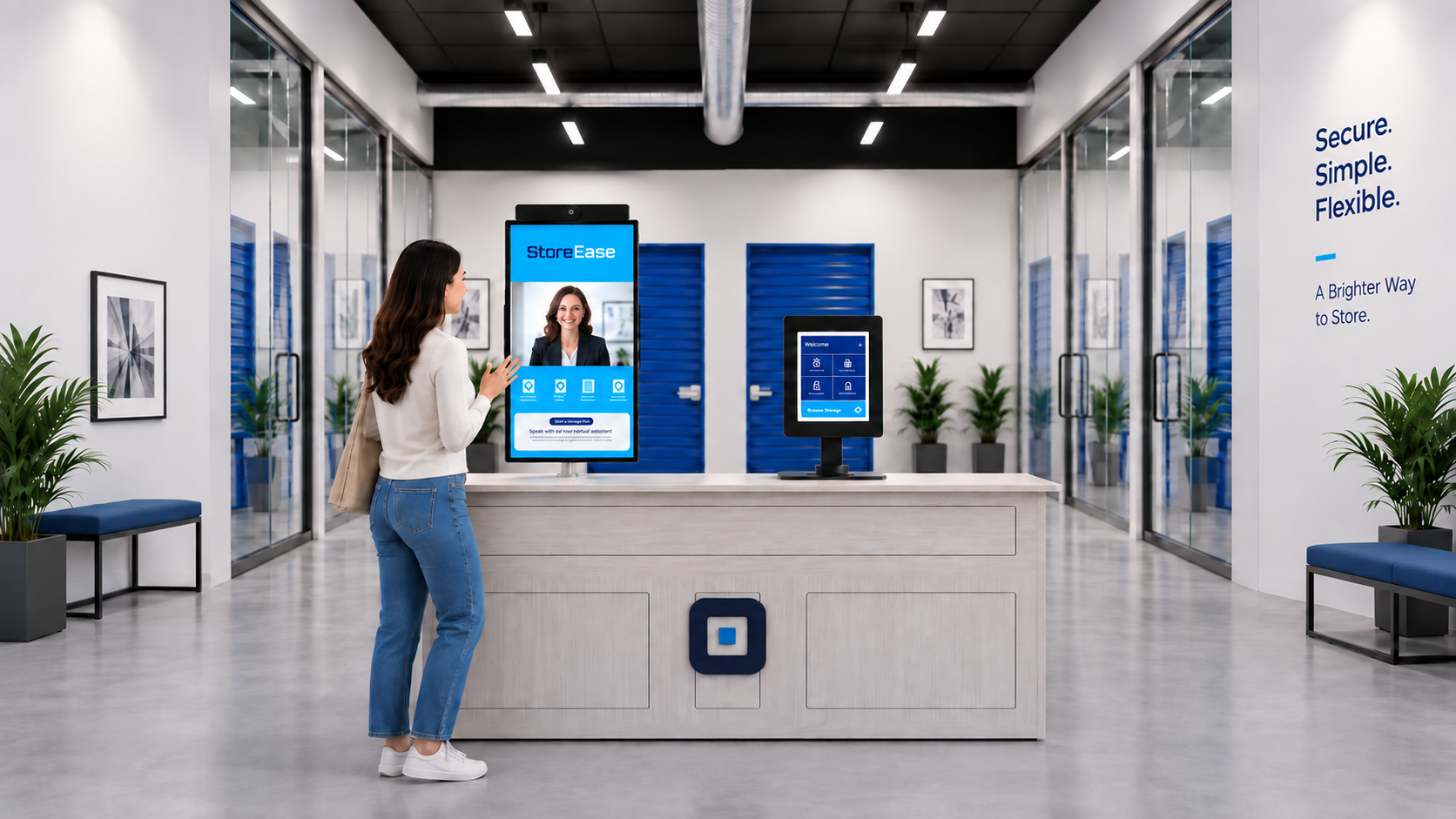
That is why we built EaseOS. It connects every channel and measures every interaction. In the office, Ease Virtual Console, a screen installed at the counter, puts a live manager in the room. It is not a kiosk: a great virtual manager on screen proactively greets every customer who walks in, so the customer gets the experience they walked in for: a live person to speak with. It reproduces the traditional office experience and extends it through the early mornings, lunch hours, and evenings a single on-site employee cannot cover. And because the office is truly open longer, you can publish those hours on your Google Business Profile, so your store shows as open when a 7 a.m. or 7 p.m. (or later) searcher filters for “open now” and nearby competitors show closed. And because one virtual manager centrally covers more stores, the way a call center does, that manager gets more reps, quality goes up, cost per store comes down, and call-ins and sick days never close the office again. Customers get the same person-to-person moment that converts at more than 75 percent, not a locked door or a phone menu.
EaseOS proves you don’t have to choose between better customer experience and better economics: keep the office open, put a real person in front of every customer, capture more rentals, retain more tenants, and lower the cost of operating. Before you lock the door to save an hour of payroll, measure what that hour is actually worth. You may be closing the door on your best closer, your strongest retention tool, and the NOI you’ve been chasing.
See what an always-open office looks like at your stores.
Book a demo and we’ll walk you through EaseOS and Ease Virtual Console.
We followed more than 50,000 customer journeys from lead to lease. Here is what they show about the office, and why you should think twice before closing it.
Walk up to most self storage offices early in the morning, at lunchtime, or after five, and you will find a locked door and, at best, a phone number, a QR code, or a cold, unfriendly kiosk. At unmanned and hybrid stores, that locked door is not the exception; it is most of the day, or all of it. That door stands in front of the best-converting channel in the business, at the very moment a customer in the middle of a life change is looking for a friendly face. Every pull on that locked handle is a rental or a service moment walking away in disappointment, and no report will ever show it.
I know because I watched it happen. As an investor and developer, I went down the kiosk-and-QR-code road myself to cut office payroll. Then I watched the security footage: customers walking up to my office, looking for someone to help them, and leaving without renting or getting the service they came for. Once you see that, you cannot unsee it. As an owner, it haunts you. It is why I stopped asking how to cut the office and started asking how to keep it open and staffed.
Everything that follows comes from operating data, not theory: more than seven years running self storage offices on our virtual operating model, and more than three running it with partners, across hundreds of stores. That data points to a conclusion that runs against where much of the industry has shifted under payroll pressure and a belief that the rental journey is moving fully digital.
Retail saw it first: digital sent shoppers to the store. A 2017 Harvard Business Review study of 46,000 shoppers found that 73 percent use more than one channel before buying, and that they spend more and come back more often. Nearly three decades into the Amazon era, Americans still spent about $6.1 trillion in stores in 2025 against $1.4 trillion online, and 86 percent of shoppers start their research online even when they buy in person, according to Capital One Shopping Research. Retailers call it ROPO: research online, purchase offline. A storage unit cannot be shipped to your door, so storage is ROPO by nature. Even Extra Space, one of the most digital operators in the business, reported in its September 14, 2026 company presentation that 44 percent of its rentals closed on the web, 17 percent through the call center, and 39 percent in the store. That split shows the value of meeting customers where they want to do business: even with a strong website, nearly four in ten chose to rent in the store. And when a tenant is stuck at a gate that will not open or an overlock that needs a payment, a web form or a phone queue is not fast or intuitive. A person in the office is.
Where rentals close
Even a digital leader closes nearly 4 in 10 rentals in the store
44%
17%
39%
Web
Call center
Store
Extra Space Storage company presentation, September 14, 2026
But numbers like these only show where a rental closed, not the path a customer took to get there. Our data goes a layer deeper: we followed each customer by unique tenant ID from first contact to move-in and beyond.
75%+
Office conversion rate, the highest of any channel
50%
Of all move-ins come through the office before, at, or in the weeks after renting
60%
Of all tenant interactions, new and existing, happen in the office
StoreEase analysis of 50,000+ leads, tracked by tenant ID from first contact to move-in
We studied more than 50,000 leads, from our own stores and our license partners’, to trace how that journey actually unfolds. Web drives the most lead volume. (A web lead is any customer whose first contact is online, whether they finish the rental there or not.) It also converts nearly on par with the office: roughly 70 percent, against the office’s more than 75 percent. The phone trails at 50 percent. But web is not as self-serve as most operators assume. Some web leads leave the screen and come into the office to sign a lease, so part of web’s close rate is the office doing the work.
Conversion by first-contact channel
The office converts at a higher percentage than any other channel
Office
75%+
Web
~70%
Phone
50%
StoreEase analysis of 50,000+ leads, tracked by tenant ID from first contact to move-in
Count every move-in, from every channel, and 35 percent came into the office before or as they signed a lease. Another 15 percent rented entirely by phone or web, then showed up at the store in the weeks after to get acclimated and meet the people who run the property. Together, that is half of all move-ins walking through the office door. Leads who begin online or on the phone are not choosing those channels over the office. They are moving toward it.
The relationship does not stop at move-in. Add the existing tenants who come in month after month to pay, ask questions, and get help, and the office handles 60 percent of all tenant interactions, new and existing, more than any other channel from lead to move-out. In a month-to-month business, where every tenant re-decides to stay each month, that face-to-face relationship is not a nicety; it is how you keep them. And it compounds: since 2024, our portfolio’s average length of stay is 22.4 months, nearly 18 percent above the 19-month industry average Storable reports.
Average length of stay
Face-to-face relationships keep tenants longer
StoreEase
22.4 mo
Industry
19 mo
Nearly 18% longer than the industry average
StoreEase portfolio since 2024; industry average as reported by Storable
If your reports tell a different lead story, that is because they only see where the journey started. Most property management software records where a lead originated, not where they signed or where they touched your operations along the way. A lead tagged web stays tagged web even when they drove to the office and closed at the desk. The journey is real. The software just was not built to see it.
The office is where intent peaks and conversion is highest. It is also the channel our industry has spent decades struggling to staff. It always came down to labor: cost, coverage, and quality, not to mention the manager who calls out sick or simply does not show up. Operators who cut hours were not being careless; with the reports they had, it looked like the right call. Customers who want a live person get pushed to the phone, your weakest-converting channel, or to the open office down the road. Traditional, hybrid, and unmanned models all ask you to accept the same trade: cut staff to save on payroll, or pay for full staffing and still get limited hours and a manager whose day you cannot see. At smaller stores, where the payroll math is harder, good managers are hard to find, and the next store is often an hour’s drive away, going unmanned or hybrid is often a necessity, not a choice.
So what does a dark hour actually cost?
We measured it. Office conversion partly reflects who chooses to walk in, so we tested something harder to argue with: rentals captured. We counted only the rentals signed in the hours a traditionally staffed office sits dark: 7 to 9 a.m., lunch, and 5 to 8 p.m. after close. Staffed through those windows, each store signed an average of 30 rentals a year while a traditional office would have been locked: about 2.5 a month, from working customers who come in ready to rent because it is their only window. We cannot know how many would have come back during business hours or rented another way. But most self storage facilities rent 15 to 30 units a month, so for most stores that is one to two months of leasing riding on hours even a fully staffed office leaves dark. At $125 a month, those 30 rentals are $3,750 a month per store, or about $84,000 over our 22.4-month average stay.
Rentals in the dark hours
30/ store / year
Signed 7–9 a.m., at lunch, and 5–8 p.m.: the windows a traditionally staffed office sits dark.
STAFFED
STAFFED
7a9a12p1p5p8p
Traditional office dark
Traditional office staffed
“An unanswered call shows up in a report as lost revenue. A pull on a locked office door shows up nowhere.”
Nobody would leave numbers like that unaccounted for on the phone, the channel those customers get pushed to. No one caps the call center at a few hours a day. Nobody keeps it dark until nine, locks it at lunch, or sends it home at five. They staff it, extend it, and measure it, even roll it over to an answering service because an unanswered call shows up in a report as lost revenue or service. A pull on a locked office door shows up nowhere. The usual rationale is cost: one call center covers hundreds of stores, while an office needs a person at every one. That was true, until we found a way to staff the office like a call center: one great manager, working centrally, live in the office of every store they cover.
That is why we built EaseOS. It connects every channel and measures every interaction. In the office, Ease Virtual Console, a screen installed at the counter, puts a live manager in the room. It is not a kiosk: a great virtual manager on screen proactively greets every customer who walks in, so the customer gets the experience they walked in for: a live person to speak with. It reproduces the traditional office experience and extends it through the early mornings, lunch hours, and evenings a single on-site employee cannot cover. And because the office is truly open longer, you can publish those hours on your Google Business Profile, so your store shows as open when a 7 a.m. or 7 p.m. (or later) searcher filters for “open now” and nearby competitors show closed. And because one virtual manager centrally covers more stores, the way a call center does, that manager gets more reps, quality goes up, cost per store comes down, and call-ins and sick days never close the office again. Customers get the same person-to-person moment that converts at more than 75 percent, not a locked door or a phone menu.
EaseOS proves you don’t have to choose between better customer experience and better economics: keep the office open, put a real person in front of every customer, capture more rentals, retain more tenants, and lower the cost of operating. Before you lock the door to save an hour of payroll, measure what that hour is actually worth. You may be closing the door on your best closer, your strongest retention tool, and the NOI you’ve been chasing.
See what an always-open office looks like at your stores.
Book a demo and we’ll walk you through EaseOS and Ease Virtual Console.